The Arctic Cat 500 is a legendary machine known for its rugged durability and impressive pulling power. Many riders rely on it for tough farm work, hunting trips, and weekend trail riding.
But like any off-road vehicle that sees heavy use, it has its fair share of mechanical quirks.
Over time, mud, water, and general wear and tear can take a toll on its internal components.
If your ATV is sputtering, refusing to shift, or running hot, you are definitely not alone.
Understanding these common faults can save you serious time and money at the mechanic.
Below, we break down the most frequent issues owners face and provide practical, step-by-step solutions to get you back on the trail.
Problem #1: Carburetor Clogging and Poor Idling
Causes:
- Modern fuel often contains ethanol, which attracts moisture and leaves a gummy residue when it sits for too long.
- Dust and debris can bypass an old air filter and settle directly into the carburetor jets.
- A degraded fuel line can flake off internally, sending small rubber particles into the fuel bowl.
Fixes:
- Remove the carburetor and thoroughly clean the pilot and main jets with a dedicated carb cleaner and compressed air.
- Install an inline fuel filter between the gas tank and the carburetor to catch debris before it causes blockages.
- Drain the float bowl if the ATV is going to sit for more than a few weeks.
- Always use high-quality, non-ethanol fuel if available in your area.
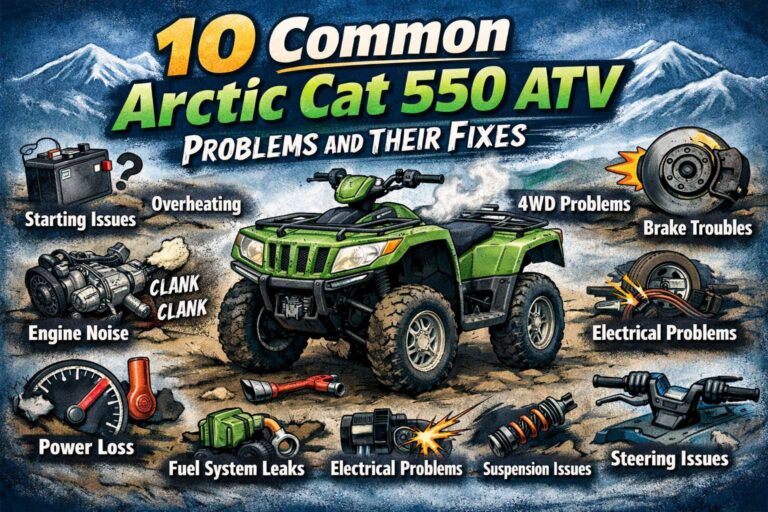
Read Also: 10 Common Arctic Cat 550 ATV Problems and Their Fixes
Problem #2: Stator Failure and Battery Drain
Causes:
- The stator is responsible for charging the battery while the engine runs, but excessive heat can melt its internal wiring.
- Deep water crossings can introduce moisture into the stator housing, causing short circuits over time.
- Running too many aftermarket electrical accessories (like light bars and winches) can overload the charging system.
Fixes:
- Test the battery voltage with a multimeter while the ATV is running; it should read around 13.5 to 14.5 volts.
- If the voltage is low, use a multimeter to check the stator’s resistance according to your service manual specs.
- Replace the stator if it fails the resistance test, ensuring you use a high-quality OEM or upgraded aftermarket replacement.
- Apply dielectric grease to all electrical connections to block out moisture.
Problem #3: 4WD Actuator Malfunction
Causes:
- The 4WD actuator sits low on the chassis, making it a prime target for water, mud, and trail debris.
- Internal plastic gears inside the actuator housing can strip out under heavy load.
- Corroded electrical connections prevent the switch signal from reaching the actuator motor.
Fixes:
- Unplug the actuator harness and clean the metal pins with an electrical contact cleaner.
- Listen for the distinct humming sound of the actuator engaging when you flip the 4WD switch.
- If it makes a grinding noise or no sound at all, remove the unit and inspect the internal gears.
- Replace stripped gears or install a manual 4WD cable conversion kit for a more permanent, bulletproof solution.
Read Also: 10 Common Argo XR 500 Problems (And How to Fix Them)

Problem #4: Engine Overheating
Causes:
- The radiator fins easily become packed with thick mud, blocking airflow to the engine coolant.
- A faulty thermostat might remain stuck closed, preventing hot coolant from flowing into the radiator.
- The electric cooling fan can fail due to a blown fuse, a bad temperature sensor, or a burnt-out fan motor.
Fixes:
- Carefully wash the radiator fins with a gentle stream of water from a garden hose after every muddy ride.
- Check the cooling fan fuse and use a jumper wire to test if the fan motor turns on directly from the battery.
- Bleed the cooling system to remove any trapped air bubbles that could be causing hot spots.
- Replace the thermostat if the radiator stays cold while the engine block gets dangerously hot.
Problem #5: Difficult Gear Shifting
Causes:
- The shift linkage rods can bend or become misaligned after hitting rocks or stumps on the trail.
- Worn-out clutch plates or an improperly adjusted auto-clutch will prevent smooth gear engagement.
- Dirty or low engine oil can increase friction within the transmission, making it notoriously stiff.
Fixes:
- Check the shift linkage for straightness and adjust the rod length until the shifter moves smoothly between gears.
- Change the engine oil using a high-quality, wet-clutch-approved ATV oil.
- Adjust the clutch tension screw on the side of the engine casing according to the service manual instructions.
- Grease the shifter pivot points to eliminate binding.
Problem #6: Starter Motor Clicking
Causes:
- A clicking sound usually points to a dead or dying battery that lacks the cranking amps to turn the engine over.
- The starter solenoid terminals can corrode, preventing full electrical current from reaching the starter.
- The internal brushes inside the starter motor can wear completely down after years of frequent use.
Fixes:
- Charge the battery fully and have it load-tested at an auto parts store to rule out a dead cell.
- Trace the thick red wire from the battery to the starter solenoid, cleaning all metal connections with a wire brush.
- Bypass the solenoid with a screwdriver (carefully) to see if the starter motor spins.
- If the motor receives power but still won’t spin, rebuild it with a brush kit or replace the entire starter assembly.
Problem #7: Suspension Bushing Wear
Causes:
- Factory rubber A-arm bushings degrade quickly when exposed to harsh trail riding and constant articulation.
- Lack of regular greasing allows sand and grit to grind away at the pivot points.
- Carrying heavy loads on the utility racks accelerates the wear on the suspension geometry.
Fixes:
- Lift the ATV on a jack and wiggle the tires side to side to check for excessive play in the A-arms.
- Remove the worn factory rubber bushings using a socket and a rubber mallet.
- Upgrade to high-density polyurethane or brass bushings for superior longevity and tighter handling.
- Pump fresh marine-grade grease into the zerk fittings after every major ride.
Problem #8: Exhaust Leaks and Popping
Causes:
- The exhaust donut gasket connecting the header pipe to the muffler easily burns out or crumbles.
- Missing or broken exhaust springs allow the pipes to vibrate apart over rough terrain.
- A lean fuel mixture (often caused by carb issues) can make the exhaust run excessively hot, damaging seals.
Fixes:
- Listen for a ticking noise near the engine block, which usually indicates a leak at the exhaust flange.
- Remove the exhaust springs and unbolt the header to inspect the soft donut gasket.
- Replace the gasket and install new, tight tension springs to hold the pipes firmly together.
- Smear a high-temp copper silicone sealant around the joints before reassembly for an airtight seal.
Problem #9: Spongy Brake Feel
Causes:
- Air bubbles can enter the hydraulic brake lines if the fluid reservoir gets too low.
- Old brake fluid absorbs moisture over time, reducing its boiling point and causing a soft pedal feel.
- Mud and grit can score the brake rotors, pushing the caliper pistons back and requiring more lever pull.
Fixes:
- Inspect the brake pads and rotors for deep gouges, replacing them if they are worn past the service limit.
- Bleed the brake system entirely, starting from the caliper furthest from the master cylinder.
- Flush the old, dark brake fluid and replace it with fresh DOT 4 fluid.
- Check the rubber brake lines for swelling or cracking, and upgrade to braided steel lines if necessary.
Problem #10: Spark Plug Fouling
Causes:
- Running with the choke pulled out for too long will coat the spark plug in heavy black soot.
- Worn piston rings or valve seals allow engine oil to slip into the combustion chamber, oil-fouling the plug.
- A weak ignition coil produces a poor spark, leaving unburned fuel to wet the spark plug tip.
Fixes:
- Remove the spark plug and inspect the tip; a healthy plug should be a light tan color.
- If it is black and sooty, adjust your carburetor air/fuel mixture screw to lean out the idle circuit.
- If the plug is wet with oil, you may need to perform a engine compression test to check the piston rings.
- Always carry a spare, properly gapped NGK spark plug in your onboard tool kit.
Keep Your Arctic Cat 500 Trail-Ready
Owning an Arctic Cat 500 means you have a highly capable machine ready to tackle tough jobs and rough trails.
While it has a few known weak points, most of these problems are easily solvable with basic hand tools and a little patience.
By staying proactive with your maintenance, cleaning your carburetor, and keeping moisture out of the electrical system, you can drastically reduce your breakdown risks.
Address small noises and leaks before they become major mechanical failures.
With a bit of grease and regular check-ups, your ATV will continue providing reliable service for years to come.
FAQs
What oil should I use in my Arctic Cat 500?
You should use a 10W-40 ATV-specific oil that is wet-clutch certified (JASO MA rating). Automotive oils contain friction modifiers that will cause your ATV’s clutch to slip.
Why won’t my Arctic Cat 500 stay running without the choke?
This is almost always caused by a clogged pilot jet inside the carburetor. The idle circuit is very tiny and blocks easily, requiring a thorough cleaning with compressed air.
How fast can the Arctic Cat 500 go?
A stock Arctic Cat 500 will generally top out around 50 to 55 mph, depending on rider weight and tire size. It is geared more toward pulling power rather than top-end speed.
Is the Arctic Cat 500 automatic or manual?
Most Arctic Cat 500 models feature a fully automatic CVT (Continuously Variable Transmission). However, earlier models were also offered with a manual foot-shift transmission equipped with an auto-clutch.